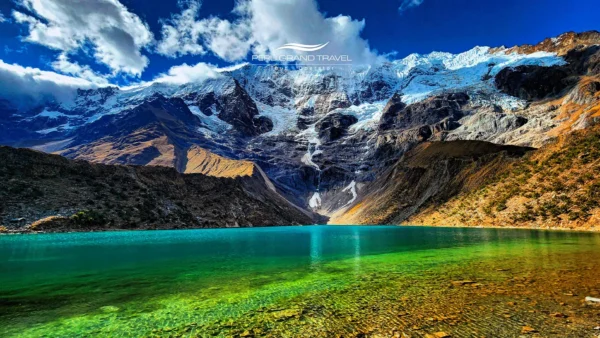
The Ausangate Snow Mountain is one of the most striking mountains in Peru and one of the most profound high-altitude landscapes in the Andes. It stands out not only for its snow, lagoons, or trekking routes, but for its cultural, spiritual, and human significance within the Andean world. Visiting Ausangate involves altitude, cold weather, and physical challenge, but also offers a rare opportunity to connect with local communities, understand a different relationship with the mountains, and experience a less touristy, more authentic and transformative side of Peru.
Table of Contents
In this guide, I will not present Ausangate as a postcard destination. I will approach it as it truly deserves: as a high-altitude territory where geography, culture, physical challenge, and one of the most powerful experiences in the Peruvian Andes come together.
What Is Ausangate Snow—and Why It’s More Than Just Snow in the Andes
Talking about the Ausangate Snow Mountain only as a snow-covered mountain is not enough. Its glaciers, turquoise lagoons, and high-altitude landscapes are impressive at first sight, but its value goes far beyond that. It is a place where nature, history, and the life of Andean communities come together in a unique way.
Location: Vilcanota Mountain Range and geographic context
Ausangate is located in the Vilcanota Mountain Range, southeast of Cusco. It is the highest mountain in the region, rising above 6,300 meters in altitude.
But beyond its height, what defines this territory is its relative isolation. There are no large tourist infrastructures or crowded routes. Access takes several hours by road from Cusco, and from that point on, the environment changes quickly.
The landscape becomes more open, more raw. High-altitude plains appear, along with herds of alpacas, lagoons formed by glacial melt, and paths that are not always clearly marked.
This geography shapes everything. The weather is more unstable, distances feel longer, and time begins to be experienced in a different way.
Cultural significance of Ausangate in Andean cosmology
For Andean communities, Ausangate is not just a mountain. It is an “Apu,” a sacred entity that protects, organizes, and gives meaning to the territory.
This idea is not symbolic in a tourist sense. It is functional. It is present in daily life, in decision-making, in agricultural practices, and in festivities.
One of the most well-known is Qoyllur Rit’i, a pilgrimage that brings together thousands of people on the slopes of Ausangate. It is not an event designed for visitors. It is an expression of cultural continuity.
Understanding this changes the way the place is perceived. The traveler stops seeing only landscapes and begins to notice invisible structures: rituals, respect for the mountain, and forms of community organization.
The difference between a tourist landscape and a living territory
In many destinations, the landscape adapts to the visitor. Defined trails, optimized timing, experiences designed to be easily consumed.
In Ausangate, the opposite happens.
The territory is not designed for the traveler. The traveler has to adapt to the territory.
This is noticeable in simple things: long hikes without clear references, sudden weather changes, communities that do not revolve around tourism, and a constant feeling of being outside a controlled circuit.
That difference is key. Here, it’s not just about “seeing.” It’s about understanding where you are.
And when that happens, the journey stops being a sum of places visited. It begins to feel like a more complex, more demanding, and often more meaningful experience.
Ausangate vs Other High-Altitude Destinations in Peru: What Makes It Different?
In Cusco, altitude is not an exception. It is part of the journey. But not all high-altitude destinations are experienced in the same way.
Some routes are designed to be accessible, visible, and quick to understand. Others require more time, more adaptation, and a different way of reading the environment. Ausangate belongs to this second group.
Comparing it with other destinations helps place it in context. Not to measure which one is “better,” but to understand the kind of experience it offers.
Comparison with Rainbow Mountain
Rainbow Mountain became one of the most visited icons of Cusco. Its appeal is clear: a powerful image, accessible in a single day, and easy to fit into almost any itinerary.
Ausangate, by contrast, does not work as a one-time experience. It cannot be reduced to a short hike or to a single specific viewpoint.
While Vinicunca focuses on one concrete point, Ausangate is built as a journey. There is no single “main moment.” Its value lies in the accumulation: landscapes, effort, weather changes, and continuous contact with the environment.
In addition, the difference in visitor flow is evident. Where Vinicunca concentrates groups, Ausangate spreads them out. That changes the perception of space and the way the mountain is experienced.
Comparison with Salkantay Trek
The Salkantay Trek is one of the most popular alternative routes to Machu Picchu. It has a clear logic: connecting diverse landscapes with a defined final destination.
That structure organizes the experience. Each stage has a concrete purpose within a larger journey.
In Ausangate, there is no equivalent final destination. You are not walking toward an icon. You are walking within a system.
This changes the way the traveler interprets the route. On Salkantay, the journey leads to something. On Ausangate, the journey itself is the center of the experience.
There is also a difference in infrastructure. Salkantay has a more developed tourism setup. Ausangate maintains a more basic operation, which increases the feeling of isolation and self-reliance.
How trekking Ausangate differs from classic Cusco routes
Ao contrário de outras rotas conhecidas em Cusco, como o Vale Sagrado, Machu Picchu ou muitas caminhadas de um dia, a caminhada Ausangate não se encaixa tão facilmente em uma viagem convencional. Nesses destinos, os horários costumam ser bem definidos, os acessos são claros e a experiência tende a ser mais previsível. No Ausangate acontece algo diferente: os dias são mais longos, a altitude está presente o tempo todo e o clima pode mudar muito rápido. Por isso, não é uma rota que simplesmente se percorre; é uma rota à qual o viajante precisa se adaptar. E é justamente aí que está o seu maior valor: na forma como obriga a mudar o ritmo, as expectativas e a maneira de vivenciar a montanha.
Trekking Ausangate: What the Experience Really Feels Like Beyond the Itinerary
Antes de fazer a caminhada Ausangate, é fácil pensar em termos logísticos: dias, quilômetros, altitude. Tudo isso importa. Mas não define completamente a experiência.
O que acontece nessa rota não se entende apenas com um mapa. Entende-se caminhando.
A partir do segundo dia, algo muda. O ambiente deixa de ser algo que se observa e passa a ser algo que condiciona cada decisão: quando avançar, quando parar, como respirar e quanto esforço investir.
É aí que a caminhada deixa de ser apenas um percurso e se transforma em uma adaptação constante.
Route options and duration
O circuito clássico do Ausangate costuma durar entre 4 e 5 dias. Ele contorna a montanha e atravessa diferentes passos de altitude, alguns acima dos 5.000 metros.
Existe também uma versão estendida que pode incluir variações até a Montanha Colorida ou rotas menos percorridas. Essas versões acrescentam dias, mas não necessariamente tornam o percurso mais confortável. Tornam-no mais completo.
Não existe uma única forma de fazê-lo. A estrutura depende do tempo disponível, do preparo físico e do tipo de experiência que se busca.
Mas, em todos os casos, há algo em comum: a continuidade. Não é uma caminhada fragmentada. É uma sequência que se constrói dia após dia.
Real difficulty: altitude, weather, and isolation
A dificuldade do Ausangate não está apenas na distância. Está na combinação de fatores.
A altitude é constante. Não há longos trechos de recuperação em áreas mais baixas. O corpo trabalha o tempo todo em condições exigentes.
O clima é variável. Pode haver sol intenso durante o dia e temperaturas abaixo de zero à noite. Vento, neve ou chuva não são exceções.
E depois há o isolamento. Não existem povoados grandes nem pontos de saída rápidos. Uma vez dentro do circuito, a margem para erro diminui.
Isso não torna a rota inacessível. Mas exige preparação real. Não basta apenas “estar em forma”. É preciso entender o ambiente.
When the Andes stop being a destination and become an environment
Em muitas viagens, a paisagem é algo que simplesmente se observa. Ela está ali, acompanha o percurso, mas não muda tanto a experiência. No Ausangate acontece algo diferente. Aqui, a montanha e o entorno influenciam tudo: o ritmo da caminhada, o esforço que você faz e a forma como vive cada dia. Depois de algum tempo, o viajante deixa de sentir que está apenas observando a montanha e começa a se sentir parte dela. É aí que a caminhada deixa de ser apenas uma atividade e se transforma em uma experiência mais profunda e consciente.
7 Lakes of Ausangate: Is It Worth It or Just a Short Alternative?
Not all travelers have the time — or always the willingness — to trek Ausangate for several days. That is where the 7 Lakes route appears as a more accessible option.
But reducing it to a “short” version of the trek would be inaccurate. It is a different experience. Shorter, yes, but not necessarily superficial.
What the 7 lakes are and how to access them
The 7 Lakes of Ausangate are a group of glacial lakes located on the slopes of the mountain.
Each lake has a different color, ranging from turquoise, green, and deep blue tones. This difference is not only aesthetic. It is caused by minerals, depth, and light.
Access is usually done in a single day from Cusco, with an early transfer to the Pacchanta area. From there, the hike begins.
The route is not technical, but it does take place at high altitude. That changes the perception of effort.
Differences between a one-day experience and full trekking Ausangate
The main difference is not in the landscape. It is in the time.
On the one-day route, the traveler enters, observes, and returns. It is a brief contact with the environment.
On the full Ausangate trek, the contact is continuous. The body adapts progressively, the pace changes, and the relationship with the surroundings becomes more direct.
The short experience allows you to see the setting. The long experience allows you to understand it.
Neither replaces the other. They respond to different intentions.
Who this route is actually for
Ausangate 7 Lakes Trek Full Day works well for specific traveler profiles.
For those who have limited time in Cusco, it offers a concrete way to get closer to the Ausangate environment without taking on a full expedition.
It is also a good option for those who want to evaluate how their body responds to altitude before considering a more demanding trek.
But there is a clear limit.
Those seeking isolation, continuity, and a deep mountain experience will not find it on a one-day route.
On the other hand, those looking for a well-measured approach — intense, but limited in scope — may find here a sufficient and well-structured experience.
Ausangate Climbing: When Trekking Is No Longer Enough
At a certain point, for some travelers, walking around the mountain stops being enough. Another question arises: what does it really mean to climb it?
Ausangate is not a mountain that can be “attempted” without context. Its presence commands respect even from a distance. Climbing it is not a natural extension of the trek. It is another category of experience.
At this stage, it is no longer only about endurance. It is about technique, planning, and tolerance for much more demanding conditions.
What climbing Ausangate really involves
The ascent of Ausangate is a high-mountain expedition. It involves several additional days, high-altitude camps, and progression across glacial terrain.
There are no defined trails as there are on the trek. The route depends on ice conditions, the weather, and how the team reads the terrain.
In addition, the acclimatization process is even more critical. It cannot be improvised. Each stage must be carefully planned to reduce risks.
The goal is no longer to move through a landscape. It is to reach a summit in a technical environment.
Technical level and real risks
Unlike the trek, this requires previous mountain experience.
The use of crampons, an ice axe, ropes, and ice progression techniques is part of the ascent. It is not optional.
The risks also change in scale. Hidden crevasses, sudden weather changes, falling ice, and accumulated fatigue are real factors.
This does not make the experience inaccessible, but it does make it selective. It is not designed for every type of traveler.
Key differences between trekking and mountaineering
The Ausangate trek is demanding, but predictable within certain limits. It can be planned with relative clarity.
Mountaineering does not offer that same stability.
On the trek, the body adapts to the environment. In climbing, the margin for adaptation is smaller, and mistakes have more direct consequences.
The objective also changes. In trekking, the value lies in the process. In climbing, there is a concrete objective: the summit.
That difference redefines the experience.
Moving from trekking to ascent is not a natural progression. It is a different decision, one that involves another level of preparation, another type of motivation, and a more technical relationship with the mountain.
How to Prepare Step by Step for Ausangate Snow
One of the most common mistakes before doing Ausangate is thinking that everything depends on the gear. Many travelers arrive with good clothing, a suitable backpack, and acceptable physical condition, but without a clear idea of what altitude really involves. They confuse being equipped with being prepared. And on a route like this, those are not the same thing. Real preparation begins before you start walking: in the way you understand the environment, the weather, and the demands of the mountain.
Acclimatization: what most travelers get wrong
Acclimatizing is not something that should be taken lightly. Spending one or two days in Cusco is not always enough for the body to get used to the altitude. Many people make the mistake of wanting to start too quickly, hike hard from the beginning, or not give much importance to symptoms such as headaches or fatigue. In Ausangate, those mistakes are felt more strongly. The best approach is to take it step by step: first adapt in Cusco, then do shorter hikes, and only after that begin the more demanding route.
Essential gear vs unnecessary items
Not everything sold as “mountain gear” is necessary. And not everything that is necessary is obvious.
In Ausangate, the weather changes quickly. That makes layering more important than bulk. Thermal clothing, a good waterproof layer, wind protection, and well-tested footwear make the difference.
What is usually unnecessary is the excess: clothes that are never used, duplicate accessories, or extra weight carried without a clear purpose.
Every additional kilo can be felt. And at high altitude, it is felt even more.
Being well prepared does not mean carrying more things. It means carrying the right ones.
Logistics: guides, transport, and timing
Ausangate is not a route where logistics can be figured out along the way.
Transportation to the starting point, time coordination, the availability of guides or muleteers, and gear management are all structural parts of the experience.
Here, having a local guide does not only provide safety. It provides context. It helps read the weather, interpret the terrain, and adjust decisions in real time.
It also influences the pace. A poorly planned itinerary can turn a good route into an exhausting experience.
On the other hand, well-designed logistics make everything flow more naturally, even in a demanding environment.
Best Time to Visit Ausangate: Snow, Weather, and Strategic Decisions
Choosing when to go to Ausangate is not a logistical detail. It is a decision that completely changes the experience.
Here, the weather is not just a backdrop. It is an active factor. It defines visibility, difficulty, pace, and, in many cases, the type of experience you are going to have.
Talking about the “best season” is not enough. You need to understand what each period really implies.
Dry season vs shoulder season
The dry season, between May and September, usually offers more stable conditions. Days with clear skies, better visibility, and a lower chance of continuous rain.
This makes trekking easier. The trails are firmer, and planning becomes more predictable.
But there is also a trade-off: lower temperatures, especially at night. The cold is more intense and more constant.
The shoulder season — April and October, and even part of November — brings greater variability. There may be rain, clouds, and faster changes in the weather.
In return, the landscape feels different. More contrast, more presence of water, and fewer visitors.
It is neither better nor worse. It is another version of the same place.
What “seeing snow” actually means in Ausangate
One of the most common misunderstandings is thinking that snow depends exclusively on the season.
In Ausangate, snow is present year-round in the higher areas. It is part of the mountain’s glacial environment.
What changes is not its existence, but the way it is perceived.
During the dry season, clear skies make it easier to see the snow-capped peaks, but the surroundings may feel drier in the lower areas.
In wetter seasons, the contrast increases. The snow stands out more against green or humid landscapes, but visibility may be limited.
“Seeing snow” is not a guarantee or an isolated variable. It is the result of several factors: altitude, weather, and time of day.
How weather reshapes the experience
In Ausangate, the weather changes the experience a lot. A sunny day makes the trek feel clearer and more pleasant. A day with wind or clouds can make it more demanding. That does not mean it is worse, only different. That is why it is important to understand that the mountain is not always experienced in the same way.
Where the Real Value Begins: Communities, Culture, and Andean Life
In Ausangate, the landscape captures attention from the very first moment. But the place cannot be understood only through its mountains and lagoons. The life of the Andean communities that inhabit the area is also important, as they are adapted to the altitude, the climate, and a very different way of living. When the traveler understands that, they stop seeing only a beautiful landscape and begin to better understand everything that makes this territory special.
Interaction with Andean communities
During the Ausangate trek, it is common to come across local families, alpaca herders, and small villages. They are not there to receive tourists, but because that is the place where they live. Many times, the contact is brief: a greeting, a glance, or a small exchange. And that is precisely what gives value to the experience. It is not about visiting communities as part of a staged activity, but about understanding that you are traveling through a territory where there is life, customs, and its own rhythm. When the traveler understands that, the way they look at the place changes completely.
Extractive tourism vs conscious travel
Travel does not always mean the same thing. Sometimes people travel to see things quickly, take a few photos, and move on. Other times, they travel to understand. In Ausangate, that difference is felt clearly. The territory is not completely adapted to the tourist: it has its own rhythms, natural limits, and ways of life that are not immediately explained. That requires the traveler to move more slowly, pay closer attention, and relate to the place in a more respectful way.
The guide as a cultural translator
On routes like Ausangate, the guide is not only there to show the way. They also help you better understand everything that surrounds the experience. They can explain why communities live in certain areas, how they work with their animals, what the mountain represents for local people, and how to interpret weather changes that a visitor might not notice. Without that explanation, the trek is still beautiful, but it is understood less. With a good guide, the landscape stops being just something you see and begins to take on a deeper meaning.
Is Ausangate Snow Worth It for Your Type of Trip?
There are destinations that work for almost any traveler. Ausangate is not one of them. This route is not designed to adapt to every plan or every expectation, and that is part of its value. When it fits the way a person likes to travel, the experience usually feels much more intense and meaningful. That is why, rather than deciding whether it is worth it in general terms, it makes more sense to ask whether it truly matches the kind of journey you are looking for.
For adventure travelers
If you are looking for a demanding trek, with fewer people and more contact with the mountain, Ausangate is a great option. It is a route that requires effort, adaptation, and respect for the environment. It is not only a physical challenge, but also an experience that demands being prepared for the altitude and the weather. For adventure travelers, it is often one of the most special routes in Peru.
For cultural travelers
At first, Ausangate may seem like an experience centered on mountains, lagoons, and trekking. However, as you travel through it, it becomes clear that it is also a territory where Andean culture remains alive and visible. There are no large tourist setups or constant explanations; instead, there is real context, observation, and interaction with a human and natural environment that continues at its own pace. That is why travelers with a cultural interest often find this to be an especially valuable experience.
For comfort or luxury-oriented travelers
In its classic format, Ausangate is not designed for travelers who prioritize total comfort. The environment is demanding, the infrastructure is basic, and the weather can be harsh. However, there are better-organized versions, with private services and more fully equipped camps, that allow the route to be experienced with greater comfort. Even so, there is a clear limit: the altitude, the cold, and the nature of the terrain still define the experience. That is why Ausangate is not a conventional luxury destination, but rather an adventure that can be lived with more balance when it is well planned.
FAQ – Ausangate Snow
What is Ausangate Snow?
Ausangate Snow Mountain is the highest mountain in southern Peru, located in the Vilcanota Mountain Range. It is known for its glaciers, glacial lakes, and high-mountain trekking routes, as well as for its cultural importance as a sacred mountain in the Andean worldview.
Where is Ausangate located?
El Ausangate se encuentra a aproximadamente 3 horas al sureste de Cusco, en la Cordillera Vilcanota, dentro de la región andina del Perú.
How difficult is the Ausangate trek?
The Ausangate trek is considered demanding. It takes place at over 4,500 meters above sea level, with passes that exceed 5,000 meters. The difficulty comes from the combination of altitude, changing weather, and long distances.
Do you need a guide for trekking Ausangate?
Yes, it is highly recommended. Due to the isolation, the altitude, and the lack of signage on some sections, a local guide provides safety, orientation, and cultural context throughout the route.
What is the 7 Lakes of Ausangate tour?
It is a one-day route that allows you to visit seven glacial lakes located on the slopes of Ausangate. It is a shorter alternative to the full trek, ideal for those who have less time.
When is the best time to visit Ausangate?
The best time is usually during the dry season, between May and September, when there is less rain and greater weather stability. However, Ausangate can be visited year-round with proper preparation.
Can beginners do the Ausangate trek?
It is not ideal for beginners without experience at high altitude. It is recommended to have good physical condition and to complete an acclimatization process before starting the trek.
What is the altitude of Ausangate Mountain?
Ausangate Snow Mountain reaches approximately 6,384 meters above sea level, making it one of the highest peaks in Peru.
Is Ausangate colder than Machu Picchu?
Yes. Ausangate is significantly colder because of its altitude and exposure. Temperatures can drop below freezing, especially at night.
Is Ausangate worth visiting?
Yes, especially for those who are looking for a more authentic mountain experience, less touristy and with a deeper connection to nature and Andean culture.

Experiences

Machu Picchu Challenge 8D/7N
Cusco, Sacred Valley Humantay Lagoon, Rainbow Mountain & Machu Picchu.
View Tour
Colonial Lima and Sacred land of the Incas 7D/6N
Lima, Cusco, Sacred Valley & Machu Picchu.
View Tour