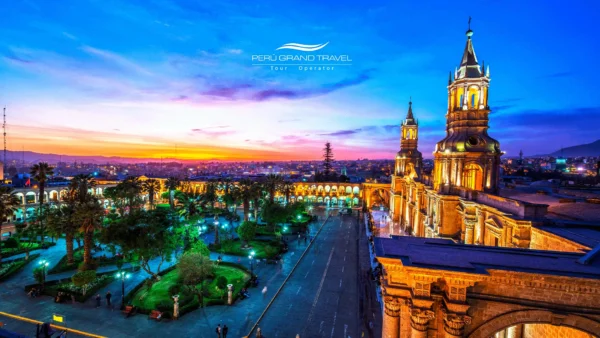
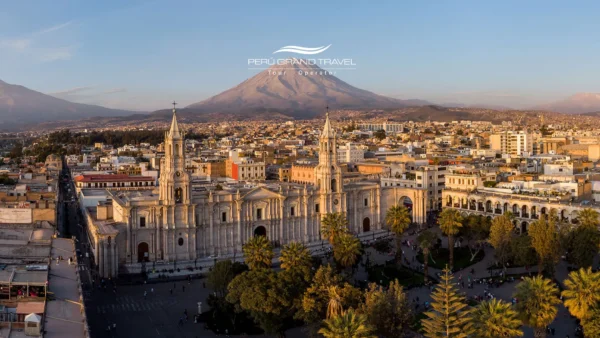
Arequipa’s altitude does not usually cause serious problems, but it should not be ignored either. Some travelers may feel tired, experience a mild headache, or have irregular sleep during the first few hours, especially if they arrive without resting or ascend too quickly to the Colca Canyon. The point is not to fear the altitude, but to understand how it can affect the pace of the trip. Staying hydrated, avoiding intense physical effort on the first day, and organizing the itinerary well can make the difference between a reasonable adaptation and a poorly planned experience.
Table of Contents
What Is Arequipa’s Altitude and What Does It Really Mean for Travelers?
Arequipa’s altitude is approximately 2,335 meters above sea level. For many travelers, that figure may seem moderate, but in practice it can have more influence than expected.
For someone arriving from Lima, which is practically at sea level, the change is real. Not dramatic, but real.
At that altitude, atmospheric pressure is lower, and with it, oxygen availability decreases as well. The body notices it. Not always as obvious altitude sickness, but as a process of adjustment.
This can translate into shorter breathing when walking quickly, early fatigue, or disrupted sleep during the first night.
Many travelers do not attribute this to altitude.
They assume it is the flight, the time change, or simply the fatigue of travel.
How High Is Arequipa and How Does It Compare to Other Cities in Peru?
Comparing helps provide context:
- Lima: ~154 m
- Arequipa: ~2,335 m
- Cusco: ~3,399 m
- Chivay: ~3,635 m
This means Arequipa’s altitude is well below Cusco’s, but still much higher than what many international visitors normally experience.
And that middle point often causes confusion.
Arequipa is usually presented as a colonial city, a gastronomic destination, or a base for visiting Colca, but it is rarely explained that it is also a high-altitude city.
That nuance matters.
Because it influences what may make sense to do on the first day.
What Changes in the Body When Arriving from Low Altitude?
The body’s response is not the same for everyone. Some travelers hardly notice the change, while others feel it as soon as they arrive. Age, hydration, physical condition, sleep, and even something many people overlook — anxiety — can all play a role, as anxiety may make faster breathing feel worse than it really is.
But there is a pattern that often repeats itself. The first 12 to 24 hours are usually the most sensitive. This is when the body begins to adapt to Arequipa’s altitude, and when many decisions — resting, walking too much, eating heavily, or pushing too hard too soon — can make a difference.
That is why many mistakes happen right after arrival:
- taking a long city tour without resting
- eating a heavy meal right after landing
- climbing stairs quickly and assuming shortness of breath is irrelevant
- scheduling an early transfer to Colca the next day
Individually, these are not usually serious mistakes. Walking too much on the first day, not drinking enough water, or forcing the pace too soon may seem like minor decisions. At first glance, they may not seem to have consequences.
But combined, they can make an adaptation process that could have been simple feel much harder. That is the main point. Arequipa’s altitude rarely ruins a trip. The problem usually lies in ignoring it and allowing small, poorly understood decisions to weigh more than necessary.
Can You Feel Altitude Sickness in Arequipa, or Is It Usually Exaggerated?
When people talk about altitude sickness in Arequipa, some minimize it completely while others exaggerate it. Both views are usually not very helpful. The reality lies somewhere in between.
Arequipa does not usually cause severe altitude sickness in most travelers. But that does not mean the altitude goes unnoticed.
It can be felt mildly, and precisely for that reason, it is often misinterpreted: a slight headache is blamed on the sun; fatigue, on the flight; poor sleep, on a different bed; lack of appetite, on the schedule.
Sometimes all of that may be true. But they can also be normal responses of the body adjusting to altitude. The problem is not feeling those symptoms, but ignoring them when the itinerary continues toward higher areas. Mild discomfort in Arequipa can be a useful sign to reconsider the pace before going up to Chivay or the Colca Canyon area. That is the value of understanding the context: not to become alarmed, but to read the journey better.

Common Symptoms and Misinterpretation Mistakes
When altitude sickness appears in Arequipa, it usually shows up in a moderate way:
- unexpected tiredness
- mild headache
- shortness of breath with little effort
- irregular sleep
- a feeling of heaviness or physical slowness
- reduced appetite or slight nausea
These symptoms do not always appear together, nor do they necessarily last long. In many cases, they disappear within a few hours. But even mild symptoms can become more noticeable when combined with common mistakes:
- Arriving and walking too much on the same day.
- Drinking too little water.
- Drinking alcohol on the first night.
- Eating a heavy meal right after landing.
- Sleeping only a few hours and going on a long excursion the next day.
Individually, these may seem like minor details. Together, they can make an adaptation process that could have been simple much harder. There is also a common conceptual mistake: believing that altitude sickness only exists when intense symptoms appear. That is not always the case. Many times, uncomfortable adaptation begins with subtle signs, and it is better to recognize them before ignoring them.
What to Do on the First Day to Adapt Better
The logic is simple: reduce anything that forces the body to work harder while adapting to Arequipa’s altitude. Walk slowly, avoid long inclines, do not make unnecessary physical efforts, prioritize water over alcohol, eat light meals, and go to sleep early. These are not dramatic measures, but they are often more useful than many improvised solutions.
What Changes When Traveling from Arequipa to the Colca Canyon?
Here, many travelers believe they are still within the same altitude logic as Arequipa. But they are not: the conditions change.
Traveling from Arequipa to the Colca Canyon is not just continuing a scenic route. In many cases, it means gaining considerable elevation in just a few hours, precisely when the body may still be finishing its adaptation.
That changes the physiological context, and that is why the transition matters. Some travelers feel fine in Arequipa and assume that guarantees good adaptation in Colca. That conclusion may be premature.
Because one thing is responding well at 2,335 meters. Another is ascending toward areas that rise well above 3,500 meters. It is not the same condition, and it does not demand the same from the body.
That change is exactly what many itineraries oversimplify. Colca is presented as a natural continuation of the trip, when in reality it can become a second stage of adaptation.
Understanding this allows for better planning: not only the route, but also the pace at which the body reaches it.

Colca Canyon Altitude and Chivay Altitude
Talking about the altitude of the Colca Canyon requires an important clarification: there is no single altitude. The canyon is a wide territory, with towns, viewpoints, and routes located at different elevations.
But for most travelers, the practical reference point is usually Chivay, at around 3,635 meters above sea level. Reaching it means climbing more than 1,300 meters from Arequipa, and that difference is no longer minor: the body can feel it.
Many road routes to Colca cross passes that are much higher than Arequipa’s altitude. Some routes reach nearly 4,900 meters in areas such as Patapampa, known as the Viewpoint of the Andes.
That detail matters. Even if the pass is brief, the body perceives the change: shorter breathing, greater fatigue, a feeling of pressure, and more intense cold.
All of this can feel stronger than in the city of Arequipa. That is why Chivay’s altitude should not be seen as a simple logistical detail. It is a condition that can influence how you sleep, how you walk, and how much you can truly tolerate the excursion.

Why This Transition Can Feel More Intense Than Arequipa City
The difference with Arequipa’s altitude is not only in the number of meters. It is also in the speed of the ascent, a factor many travelers underestimate.
It is not the same to ascend gradually over several days as it is to gain significant elevation by road in just a few hours. The body has less time to adapt, and that can be felt. That is why some people report feeling better in Cusco than during the route to Colca: not because Cusco is lower, but because the way they ascended was different.
That nuance matters. Altitude should not be understood only as a number, but as a process.
- Where are you ascending from?
- How much rest have you had?
- After how many nights in Arequipa?
- At what pace?
These questions are often more useful than simply asking how many meters high the destination is. Many mistakes happen when travelers spend only one night in Arequipa and leave early the next day for Colca without observing how their body has responded.
It can work. But it is not always the best decision, especially if the traveler arrived tired, slept poorly, or started noticing mild signs of adaptation.
Does the Altitude of Misti Volcano Make It a Different Kind of Decision?
Yes. Here it is important to separate two things that many travelers tend to mix up: one is visiting Arequipa; another, very different one, is considering an activity linked to ascending the Misti volcano.
They are not variations of the same effort. They are different scenarios, with different demands on the body and on proper planning when Arequipa’s altitude is part of the context.
Because when talking about the altitude of Misti volcano, we are no longer evaluating urban adaptation at 2,335 meters, but exposure to a mountain that reaches approximately 5,822 meters above sea level.
The difference is enormous: more than 3,400 meters above the city. That changes the level of difficulty, the body’s response, the margin for error, and also who should seriously consider that ascent.
Many travelers look at Misti from Arequipa and see it as part of the landscape: imposing, close, almost familiar. But one thing is seeing it from the city, and another is making it a trekking objective. At that point, the conversation stops being merely touristic and becomes technical.
The Difference Between Visiting Arequipa and Attempting a High-Altitude Ascent
A common mistake is thinking that because someone felt fine with Arequipa’s altitude, or even in Colca, an ascent to Misti automatically falls within what is reasonable.
Not necessarily.
A high-altitude hike involves different variables:
- accumulated elevation gain
- prolonged physical effort
- exposure to cold
- fatigue caused by lower oxygen levels
- loose volcanic terrain in some sections
- slower recovery
Most ascents to Misti are done in two days.
Usually, travelers go by vehicle to an approach point, complete a partial ascent on foot, camp overnight, and begin the summit attempt before dawn.
This is not a light excursion. It is a physically demanding activity, even for active people. Here, altitude stops being a secondary variable and becomes a central part of the risk.
Above certain ranges, the problem is no longer just discomfort. It can mean lower performance, dehydration, exhaustion, or simply a poor decision caused by overestimating one’s own adaptation.
What Travelers Often Underestimate About This Change
This usually happens with two types of travelers. The first: travelers in good physical condition who believe that cardiovascular endurance automatically means tolerance to altitude. It does not. Being fit helps, but it does not replace acclimatization.
The second: travelers who have already done moderate hikes and assume that a high mountain works like a longer version of the same thing. That is where the mistake begins: not only does the distance change, but also the condition under which the body must respond.
Not quite. The altitude of Misti volcano changes the nature of the effort. It is not just walking more; it is walking differently, with less margin and under a different level of demand.
That is why the prudent decision is not always to ask whether it is possible to climb it, but whether it makes sense within the trip being planned.
If someone arrives with only a few days, without real time to adapt, and also plans to continue toward other high-altitude areas of southern Peru, adding a demanding ascent may not be the best combination.
Not because it is impossible, but because it can become unnecessarily hard. That nuance matters: altitude does not make Misti impossible, but it does make it irresponsible to treat it like just another excursion.
How to Plan Better If Arequipa Is Part of a Higher-Altitude Route?
This is where understanding altitude stops being isolated information and becomes a strategy. Many problems do not appear because of a single destination, but because of accumulation.
It is not necessarily Arequipa. It is not necessarily Colca. Sometimes, it is the full sequence that overloads the body.
Arriving in Arequipa, going up to Chivay too soon, continuing to Cusco, and then adding hikes or high-altitude excursions within just a few days may seem reasonable when looked at separately.
But the body does not read the trip as isolated destinations. It reads the full sequence.
That is a common mistake on routes through southern Peru: thinking in terms of places, not progression. Altitude does not work like a list. It works as accumulation.
Common Mistakes When Combining Arequipa, Colca, and Cusco
One of the most frequent mistakes is designing the trip based only on geographical logic: “Since it is on the route, I will do Arequipa, then Colca, and then Cusco.”
On the map, it may make sense. For the body, not always. Altitude is not organized by proximity, but by adaptation.
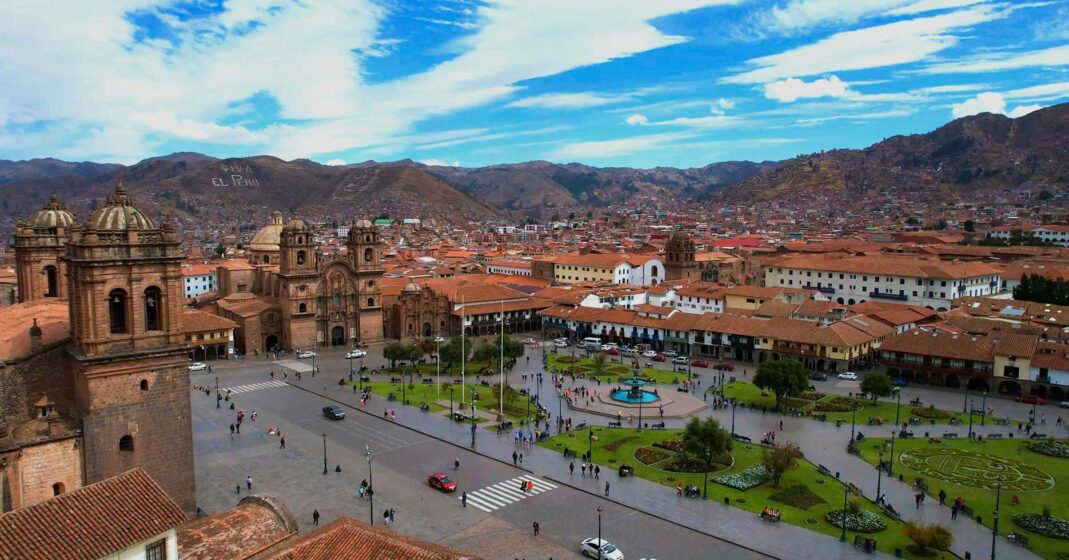
Going from Arequipa’s altitude, at 2,335 meters, to more than 3,600 meters in Chivay, crossing passes close to 4,900 meters, and then continuing to 3,399 meters means several Cusco’s altitude exposures in a short period of time.
That does not necessarily cause problems, but it can increase accumulated fatigue. And that fatigue is often misinterpreted: the traveler thinks they are exhausted from the trip, when perhaps the itinerary needed a different distribution.
Another frequent mistake is reducing the timing too much: one night in Arequipa, one night in Colca, and an immediate departure to another destination. That pace may work for some travelers, but it is not always the smartest option, especially for older travelers, people sensitive to altitude, or those arriving after long international flights. The effect of combining altitude with long road journeys is also underestimated. It is not just altitude: it is altitude plus wear and tear. And that changes the result.
When It Makes Sense to Adjust the Itinerary
Sometimes, small adjustments make a bigger difference than major changes: spending one extra night in Arequipa before going up to Colca, avoiding demanding activities on the day of arrival, or not linking several high-altitude destinations without pauses.
Thinking about the order of the trip based on adaptation, and not only on distances, can greatly improve the journey. Even Arequipa’s altitude can work as a useful transition before Cusco, precisely because it is lower. But that works best when it is understood and used consciously.
That is the kind of judgment that makes a difference in a well-designed itinerary. It is not just about adding destinations, but about understanding how they connect. At Peru Grand Travel, this logic is part of how each route is structured: not only by thinking about places, but also about the real pace of the trip.
Because, in the end, an itinerary built by accumulating attractions may look similar to one built with judgment. But they are not the same.

Experiences

Machu Picchu Challenge 8D/7N
Cusco, Sacred Valley Humantay Lagoon, Rainbow Mountain & Machu Picchu.
View Tour
Colonial Lima and Sacred land of the Incas 7D/6N
Lima, Cusco, Sacred Valley & Machu Picchu.
View Tour