The Lord of the Earthquakes is one of the most powerful religious and cultural symbols of Cusco, deeply rooted in the city’s history and collective identity. More than a religious image, this devotion represents faith in times of uncertainty, resilience after destruction, and a living tradition that continues to unite generations of Cusqueños year after year. Its presence is felt not only inside churches, but also in the streets, in homes, and in the hearts of the people.
Table of Contents
What truly makes the Lord of the Earthquakes unique is the way it blends Catholic faith with Andean spirituality, reflecting Cusco’s diverse and complex past. Born from a moment of crisis after a devastating earthquake, the image became a symbol of protection and hope, transforming fear into devotion. Today, this tradition remains alive through processions, rituals, and symbols that connect the colonial era with ancient Andean worldviews.
Experiencing the Lord of the Earthquakes is not just about witnessing a religious event; it is about understanding the soul of Cusco. It is a moment where history, faith, and living culture come together, offering visitors a unique opportunity to see how tradition continues to shape daily life in one of the most historic cities of the Andes.
Who Is the Lord of the Earthquakes?
The Lord of the Earthquakes is the most venerated religious image in Cusco and one of the deepest symbols of faith in southern Peru. It is a colonial-era crucified Christ, regarded as the city’s spiritual protector against natural disasters, especially the earthquakes that have shaped its history.
Devotion to the Lord of the Earthquakes dates back to the 17th century, when a powerful earthquake struck Cusco in 1650. According to tradition, when the image was taken out in procession through the streets, the tremors ceased, solidifying its reputation as a miraculous Christ. From that moment on, the Lord of the Earthquakes became a central figure in Cusco’s religious life and a powerful link between Catholic faith and Andean beliefs.
Beyond its religious meaning, the Lord of the Earthquakes represents identity, collective memory, and resilience. For the people of Cusco, it is not only a sacred image, but a living symbol that accompanies the city through moments of hardship and celebration. Its presence remains a reminder of the deep connection between history, spirituality, and culture that continues to define Cusco today.
Historical Origins of the Lord of the Earthquakes
The origins of the Lord of the Earthquakes date back to the colonial era and are deeply connected to one of the most dramatic events in the history of Cusco: the great earthquake of 1650. This devastating quake destroyed much of the city and left the population in a state of fear and uncertainty, at a time when natural disasters were commonly interpreted as divine signs.
According to historical tradition, during the earthquake the faithful took in procession a crucified image of Christ that was housed in the Cusco Cathedral. Shortly after the procession began, the tremors ceased—an event that was interpreted as a miracle. From that moment on, the image was recognized as the city’s protector and began to be venerated with deep devotion under the name Lord of the Earthquakes.
Over time, this devotion became firmly established and integrated into Cusco’s identity. The image not only survived centuries of history, but also evolved into a symbol that merges the Catholic faith brought by the Spanish with elements of the Andean worldview, in which the earth and its natural forces hold a central role. In this way, the Lord of the Earthquakes moved beyond being a religious image to become a historical and cultural emblem that continues to shape the spiritual life of Cusco to this day.
Religious and Cultural Significance in Cusco
The Lord of the Earthquakes holds a meaning in Cusco that goes far beyond religion. For the faithful, it represents protection, hope, and faith in the face of uncertainty, especially in a region historically marked by earthquakes. Each year, thousands of people renew their devotion by asking for health, work, family well-being, and protection for the city, reaffirming a deeply rooted spiritual bond.
From a cultural perspective, the Lord of the Earthquakes is a symbol of collective identity. Its devotion reflects the fusion of Catholicism introduced during the colonial period with the Andean worldview, in which the earth, nature, and their forces hold a sacred place. This blend is expressed in rituals, in the symbols used during the celebration, and in the way the population experiences the procession as a communal act, not solely a religious one.
In Cusco, the Lord of the Earthquakes is also living memory. Its image evokes centuries of history, resilience, and cultural continuity. More than a tradition of the past, it remains an active expression of contemporary Andean spirituality, uniting generations and reminding us that faith, history, and culture continue to walk together at the heart of the city.
The Lord of the Earthquakes Procession
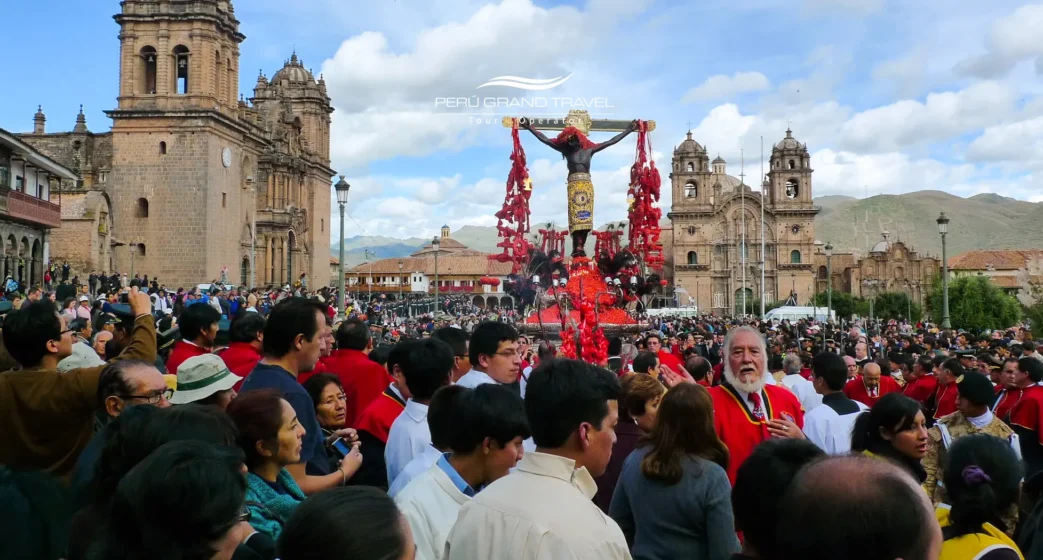
The Procession of the Lord of the Earthquakes is the most anticipated and emotionally powerful moment of this tradition, and it takes place every year on Holy Monday in Cusco. From early morning, thousands of faithful and visitors gather around the Cusco Cathedral, creating an atmosphere of deep reflection, respect, and devotion that can be felt throughout the entire city.
During the procession, the image of the Lord of the Earthquakes moves through the main streets of the historic center, accompanied by prayers, hymns, and the reverent silence of the crowd. Along the route, the faithful throw ñucchu flowers and offer prayers, asking for protection for their families and for the city. Every step of the platform is filled with symbolism and emotion, turning the journey into a collective act of faith.
Beyond its religious significance, the procession is a living cultural expression. Neighbors, institutions, brotherhoods, and entire generations actively participate, showing that this tradition remains an essential part of Cusco’s identity. Witnessing the procession of the Lord of the Earthquakes allows visitors to understand how faith, history, and community come together in one of the most important and moving rituals in Peru.
Traditions and Rituals During the Celebration
The celebrations in honor of the Lord of the Earthquakes are filled with traditions and rituals that have been passed down from generation to generation in Cusco. Every gesture, symbol, and act carries deep meaning, turning this festivity into a living expression of faith and culture that goes far beyond the procession itself.
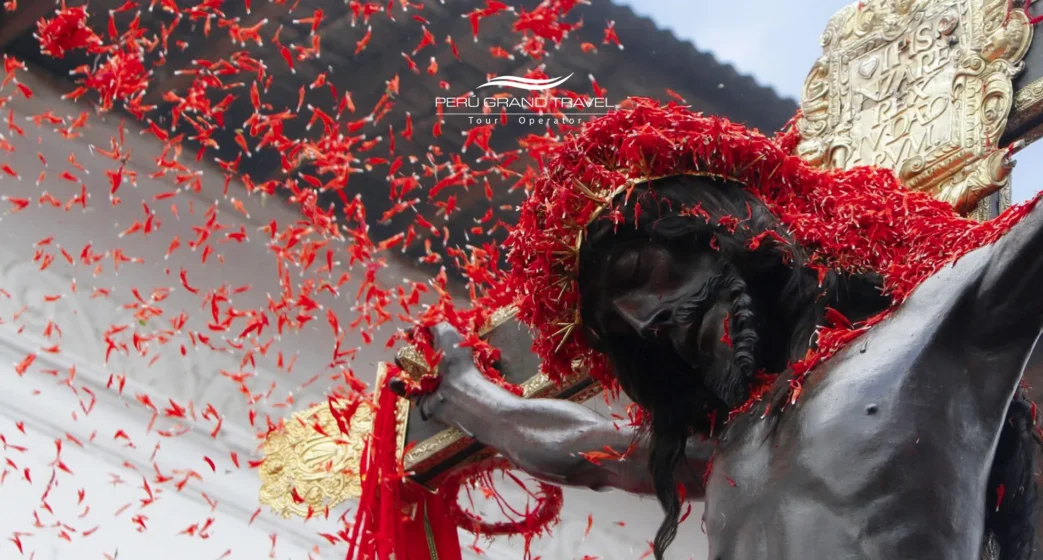
One of the most representative rituals is the throwing of ñucchu flowers along the route of the image. These deep red flowers symbolize sacrifice, life, and a connection with the earth, reflecting the Andean heritage present in the celebration. Throughout the journey, the faithful also offer silent prayers, make promises, and perform acts of gratitude, many of them tied to personal and family experiences.
Sacred music, the sound of bells, and the use of incense create a solemn atmosphere that fills the streets of the historic center. At the same time, community participation is essential: entire families, religious brotherhoods, and local authorities come together in a single act of devotion. These rituals not only honor the Lord of the Earthquakes, but also reinforce the sense of identity and belonging that keeps this tradition alive at the heart of Cusco.
The Role of Ñucchu Flowers in the Celebration
The ñucchu flower holds a central and deeply symbolic place in the celebration of the Lord of the Earthquakes in Cusco. Its intense red color is no coincidence: it represents life, sacrifice, and blood—elements that connect Christian devotion with the Andean worldview, where nature and the earth are sacred.
During the procession, the faithful throw ñucchu flowers toward the image as a gesture of respect, faith, and gratitude. This act is not only a religious offering, but also a way of keeping an ancestral tradition alive. In pre-Hispanic times, ñucchu was already used in rituals dedicated to Andean deities, reinforcing its meaning as a bridge between two spiritual worlds: the Andean and the Christian.
Today, the presence of ñucchu turns the procession into a unique visual and emotional experience. The streets are covered in red as the flower accompanies the path of the Lord of the Earthquakes, reminding us that this celebration is not only a religious act, but a living expression of cultural identity, historical memory, and spiritual continuity in Cusco.
What Travelers Should Know Before Attending
Attending the celebration of the Lord of the Earthquakes in Cusco is a profound cultural and spiritual experience, so it is important for travelers to arrive well informed and with a respectful attitude. This is not a conventional tourist event, but a deeply meaningful expression of faith for the local population.
It is recommended to arrive early, as the streets of the historic center fill up quickly and many areas are closed to traffic. Dressing in a sober and comfortable manner will help visitors blend more naturally into the atmosphere of the celebration. During the procession, silence is expected, invasive behavior should be avoided, and designated spaces for the faithful and religious authorities must be respected.
Regarding photography, while it is allowed at many moments, it should always be done discreetly and without interrupting the rituals. It is also important to follow the instructions of local authorities and event organizers. Experiencing this tradition with respect allows travelers to better understand its significance and enjoy an authentic, enriching experience deeply connected to the culture of Cusco.
Visiting Cusco During Holy Week
Attending the celebration of the Lord of the Earthquakes in Cusco is a profound cultural and spiritual experience. For this reason, it is essential that travelers arrive well informed and with an attitude of respect. This is not a conventional tourist event, but a deeply meaningful expression of faith for the local population, rich in symbolism and tradition.
It is recommended to arrive early, as the streets of the historic center fill up quickly and many areas are closed to traffic. Dressing in a sober and comfortable way helps visitors better blend into the atmosphere of the celebration. During the procession, silence is expected, invasive behavior should be avoided, and spaces reserved for the faithful and religious authorities must be respected.
As for photography, although it is usually permitted at different moments, it should always be done discreetly and without interfering with the rituals. Following the instructions of local authorities and event organizers is key to experiencing the celebration appropriately. Participating with respect allows travelers to understand the true meaning of this tradition and enjoy an authentic, enriching experience deeply connected to the living culture of Cusco.
Is the Lord of the Earthquakes Worth Experiencing as a Visitor?
Yes, it is definitely worth experiencing the Lord of the Earthquakes as a visitor, even if you do not share the religious faith. This celebration offers a unique opportunity to understand the soul of Cusco, as it brings together history, spirituality, and living tradition in a single moment that moves the entire city.
For travelers, witnessing this festivity means going beyond the usual tourist circuits. It is an authentic experience, where one can observe how an ancestral tradition continues to shape the collective identity of contemporary Cusco. The emotion of the faithful, the respectful silence of the crowd, and the symbols that accompany the procession create an atmosphere that is difficult to find in other cultural events.
In addition, experiencing the Lord of the Earthquakes allows visitors to connect with the destination from a deeply human perspective. It is not just about observing, but about feeling the respect, memory, and faith that are passed down from generation to generation. For many visitors, this experience becomes one of the most meaningful memories of their time in Cusco, precisely because of its authenticity and cultural depth.
Experience Cusco’s Traditions with a Local Guide
Experiencing the traditions of Cusco with the guidance of a local expert completely transforms the experience. Beyond simply witnessing an event, a guide provides historical, cultural, and symbolic context that allows travelers to understand the true meaning of celebrations such as the Lord of the Earthquakes, its rituals, and its deep significance for the people of Cusco.
A local guide not only explains what is happening, but also why it happens. They help interpret gestures, flowers, the silence of the crowd, and the devotion of the faithful from a respectful and authentic perspective. In addition, they offer guidance on the best places to observe the procession, how to behave during the event, and how to take part thoughtfully in a living tradition—avoiding invasive behavior or cultural misunderstandings.
For travelers, this guided experience creates a deeper connection with Cusco. It is not just about seeing a celebration, but about understanding and feeling it from within, recognizing its historical and spiritual importance. Accompanied by a local guide, the Lord of the Earthquakes ceases to be a distant event and becomes a genuine, unforgettable cultural experience.
FAQs – Lord of the Earthquakes
What is the Lord of the Earthquakes?
The Lord of the Earthquakes is the most venerated religious image in Cusco. It represents a crucified Christ regarded as the city’s spiritual protector against earthquakes and other natural disasters. Its devotion brings together Catholic faith, colonial history, and elements of the Andean worldview.
When is the procession held?
The procession takes place every year on Holy Monday as part of the Holy Week celebrations in Cusco. It is the most important religious event of this period and brings together thousands of faithful.
Is it open to tourists?
Yes, the procession is a public event and tourists are welcome to attend. However, it is essential to do so with respect, understanding that it is a deeply meaningful expression of faith for the local population of Cusco.
Can visitors take photos?
In general, photography is allowed, but it should always be done discreetly and without interfering with the rituals. It is recommended to avoid using flash, not to invade sacred spaces, and to respect moments of prayer and silence.
Why are ñucchu flowers used?
Ñucchu flowers, with their intense red color, symbolize life, sacrifice, and a connection to the earth. Their use comes from pre-Hispanic rituals and today represents the bond between Andean tradition and Christian devotion, making them one of the most representative symbols of the celebration.
More information:
- Visit our English website: Peru Grand Travel
- Visit our Spanish website: Viajes Machu Picchu Tours
- Visit our Portuguese website: Machu Picchu Pacotes

Experiences

Machu Picchu Challenge 8D/7N
Cusco, Sacred Valley Humantay Lagoon, Rainbow Mountain & Machu Picchu.
View Tour
Colonial Lima and Sacred land of the Incas 7D/6N
Lima, Cusco, Sacred Valley & Machu Picchu.
View Tour