

The best half day tour in Lima is not the one that tries to show everything. It is the one with a clear focus. If you are interested in history, the Historic
If you are looking for a more relaxed and visual atmosphere, Barranco and Miraflores usually work very well. It is also important to consider traffic, distances, and the real pace of the city. In Lima, a well-planned half day can be worth more than a poorly organized full day.
Many people see Lima only as a stop before going to Cusco. I do not see it that way. Peru’s capital does not always impress at first, but when you explore it carefully, it helps you understand the country better.
That matters because Peru is not known only for its famous landscapes. It is also discovered through its gastronomy, history, architecture, and everyday life. A good half day tour in Lima can help you connect with all of that from the very beginning.
So the real question is not only which tour to book. The more important question is which part of Lima you want to discover first. That choice can change the way you experience your entire trip through Peru.
Why do half day tours in Lima make sense for travelers with limited time?
There are cities that require several days for you to truly understand them. Lima works differently. It is not always the person who sees more places who gains more, but the one who chooses more carefully what to explore.
That is why half day tours in Lima can be a very good option. Many travelers arrive with little time, connect to Cusco, have tight schedules, or prefer to spend more days in other destinations in Peru.
In that case, a short tour does not mean a lesser experience. On the contrary, it can be a very practical and smart way to get to know the city without feeling that everything is rushed.
The reason is simple. Lima is a large, diverse city with traffic. A long and poorly organized plan can tire you out more than necessary. A well-planned half day tour, on the other hand, can give you a very clear idea of the city.
Who benefits most from a half day experience in Lima
A half-day tour usually works very well for those visiting Peru for the first time and wanting a clear introduction without committing several days. It also works well for travelers who know their main priority is Cusco, Machu Picchu, or the Sacred Valley, but do not want to pass through Lima without understanding it at least a little.
In addition, this format is a great fit for couples, families with tight schedules, travelers with long layovers, and more refined profiles, those who are not looking to simply check places off a list, but to enjoy something brief, well explained, and truly valuable.
What you can realistically see in 4 to 6 hours
In 4 to 6 hours, you can absolutely get to know a specific side of Lima with a fair amount of depth. You can explore the Historic Center and understand the city through its colonial past. You can visit Barranco and Miraflores, walk by the sea, step into cafés or galleries, and discover a more urban and atmospheric side of Lima. You can also enjoy a culinary experience with a market visit, tastings, and gastronomic context.
What you cannot do well is try to cover everything. A good half-day tour does not promise “all of Lima.” It promises a well-chosen and well-explained part of it. In a large city, that is already quite a lot.
What a half day tour cannot cover well
It does not work well for travelers who want to see everything in just a few hours. It also does not work well when it tries to combine too many districts, too many transfers, and too many expectations into a single experience.
Half a day is also not enough to understand the full complexity of Lima: its social contrasts, urban expansion, regional gastronomy, and multiple historical layers. Anyone who promises that in just a few hours is selling speed, not understanding.
What types of half day tours in Lima can you choose from?
Choosing well in Lima depends less on price than on focus. Two five-hour tours may look similar in the description, but they can offer completely different experiences. One may leave you with a clear idea of the city. The other may leave you with a sequence of stops without real depth.
In practice, half-day tours in Lima usually fall into six main categories: history, gastronomy, neighborhoods, archaeology, markets, and service format. Understanding this difference helps avoid automatic choices and improves the connection between expectation and experience.
Historic center and colonial Lima tours
This type of tour is the most logical choice for those who want to discover Lima through its historical core. The Historic Center allows you to understand the city as a colonial capital, as a seat of power, and as a place where part of its symbolic architecture is still preserved.
A good tour of this area should go beyond Plaza Mayor and quick photo stops. It should explain how colonial power was organized, what role Lima played within the Viceroyalty of Peru, and how certain religious, civic, and urban institutions still shape its identity.
For travelers interested in history, architecture, cultural heritage, and political context, this is usually one of the best options.
Food tours and Peruvian gastronomy experiences
Some people underestimate a food tour and see it as a light activity. I would say the opposite. In Lima, gastronomy is a serious way to understand the country.
A good half-day food tour should do more than just serve dishes. It should explain why ceviche holds such an important place, how coastal, Andean, criollo, and chifa traditions coexist, and how Limean cuisine reflects migration, memory, and cultural blending.
For those who want to discover Peruvian culture through taste, this is one of the most effective entry points. It also works very well with short itineraries because it concentrates a great deal of meaning into just a few hours.
Barranco and Miraflores walking tours
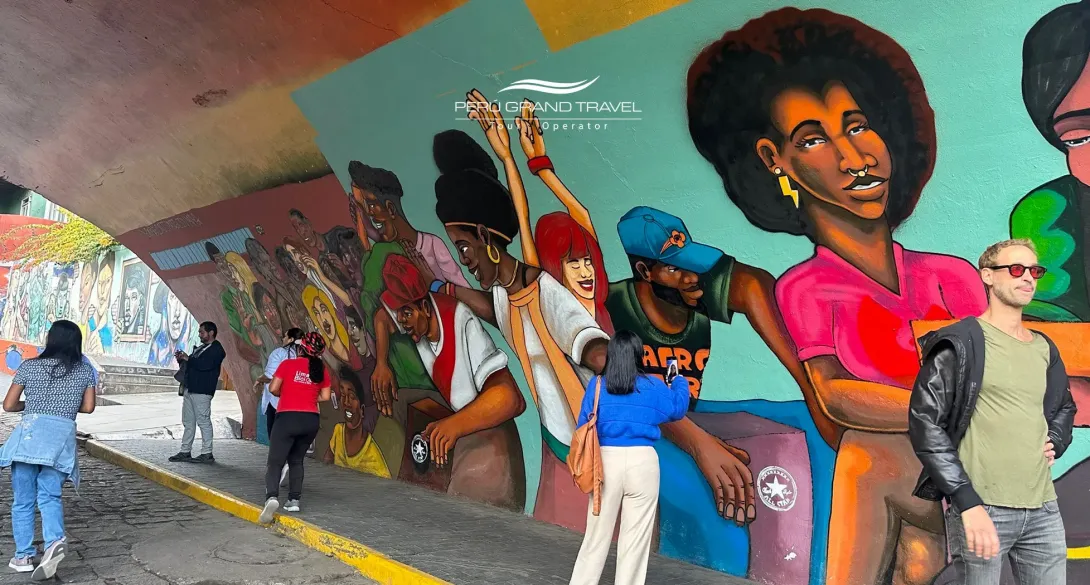
Barranco and Miraflores offer a different way of understanding Lima. Less institutional. More atmospheric. More visual. Here, the city is experienced through walking, urban art, the coastline, cafés, streets with character, and everyday life.
Miraflores offers order, accessibility, and a pleasant urban experience for first-time visitors. Barranco, on the other hand, offers texture: old mansions, murals, bridges, galleries, and a bohemian energy that tends to connect very well with couples, photographers, and travelers looking for a more sensory experience.
This type of tour is ideal for those who want a more walkable, aesthetic, and less formal side of Lima.
Archaeological and pre-Columbian culture tours
Here, a less expected side of Lima appears. Before the colonial city, there was a network of huacas, ceremonial centers, and pre-Hispanic spaces that challenge the idea of the capital as a purely modern metropolis.
A half-day archaeological tour can be an excellent choice for those who have already visited colonial historic centers in other cities and want to enter Peru through a less obvious layer. It also serves as an important reminder: Peruvian history does not begin in Cusco, nor does it end at Machu Picchu.
Local market and street food experiences
Markets bring together a less staged side of Lima. There, gastronomy connects with supply, local speech, seasonality, social mix, and everyday custom. They are especially valuable spaces for travelers seeking authenticity and direct contact with urban life.
Not every traveler enjoys this energy in the same way. Some prefer more refined experiences. But if the goal is to get closer to the real city, few places say as much as a good market explored with someone who knows how to interpret what you see and what you eat.
Private half day tours vs small group tours
Which half day tour in Lima fits your travel style best?
One of the most common, and weakest, decisions is to book by category rather than by personality. Many people say they want “a city tour” or “something food-related,” but they do not stop to think about how they travel, what they tolerate, what they tend to remember, and what they truly want to understand better.
The best experience is not always the most famous one. It is usually the one that matches the way you see.
For travelers focused on culture and history
If your natural instinct is to understand before you photograph, the Historic Center and some archaeological circuits are the best foundation. The architecture, convents, plazas, and the stories of power, religion, and urban development offer a solid structure for reading Lima more seriously.
Here, it is better to prioritize interpretive quality over the number of stops. A rushed visit loses almost all of its value.
For travelers who want gastronomy first
Those who enter a city through its table usually leave with a more vivid understanding of what is local. Lima is especially well suited to that. Peruvian cuisine, especially Limean cuisine, is not just gastronomic prestige. It is social history, cultural blending, and territory brought to life.
For this type of traveler, it is best to choose tours that combine tasting with context. Eating without explanation can be enjoyable. Eating with understanding changes the way you remember.
For couples looking for a softer, scenic experience
Barranco, Miraflores, and certain coastal walks usually work better when the goal is a more relaxed, visual, and emotionally pleasant experience. There is less historical depth, but more atmosphere, more time to walk, and less pressure in the itinerary.
For families with limited time
Families usually need simple routes, fewer transfers, and clear points of interest. A neighborhood tour or a moderate food experience usually works better than an overly historical or too fragmented itinerary.
The key here is flow. Fewer changes of scene, more consistency.
For first-time visitors to Peru
If this is your first trip, I would prioritize one of two entry points: history or gastronomy. Both offer a solid foundation. If the way you learn is through ideas, architecture, and context, I would choose the Historic Center. If you connect better with sensations, flavor, and everyday life, I would go for gastronomy.
Trying to fit everything into a first short tour usually leaves a blurry impression.
For travelers connecting Lima with Cusco or Machu Picchu
In this case, Lima should work as a prologue, not as competition. It is best to choose an experience that prepares your perspective for the rest of the country. A tour focused on Peruvian cuisine, urban history, or cultural blending can play that role very well.
How do you compare half day tours in Lima without choosing blindly?
In tourism, many purchases are made based on an illusion: believing that two tours are equivalent because they have a similar duration and attractive photos. In Lima, that is rarely true.
Two five-hour tours can offer completely different results. One may leave you with a clear idea of the city. The other may leave you with little more than a polished sense of tiredness. Comparing well requires looking at the real structure of the experience.
Duration, route, and pace
The stated duration says very little if the route is not understood. A half-day tour in Lima is not valuable because of the number of hours it takes, but because of the balance between travel time and content. If too much of the time is lost in transfers, the tour becomes weaker.
When the itinerary tries to cover too many districts in just a few hours, the promise is usually visual rather than experiential. You see more names. You understand less.
Guide quality and cultural Depth
This is often where the main difference lies. A guide should not be someone who simply lists dates or moves the group from one stop to another. A guide should act as an interpreter. In a complex city like Lima, that kind of mediation is worth more than an extra photo.
A strong guide turns a plaza into context, a recipe into history, and a neighborhood into a social expression. A weak guide only manages the schedule.
Transport, pickup, and logistics
Lima does not forgive logistical improvisation. The meeting point, hotel pickup, the order of stops, and traffic management can completely change the outcome of a short tour.
That is why it is worth checking carefully whether the service includes hotel pickup, from which areas, how long it takes to gather passengers, and how transfers between neighborhoods are handled.
Food inclusions, tickets, and hidden costs
The visible price rarely tells the whole story. Some tours seem affordable until you discover that entrance fees, minimal tastings, language supplements, or transportation costs are not included.
In food tours, for example, it is worth checking whether the tasting is merely symbolic or truly meaningful. In cultural tours, it is important to know whether convents, museums, or archaeological sites are included.
Language options and traveler profile
Language affects much more than literal understanding. It shapes tone, humor, the quality of interaction, and the depth of the narrative. It is also worth considering what type of traveler the tour seems designed for: someone who wants a lighter overview or someone looking for context and cultural insight.
Reviews that actually matter
Reviews are useful when they are read with good judgment. Generic praise does not tell me much. What really matters are the details that come up repeatedly: a clear guide, good time management, cultural content, a coherent route, and good food quality.
Specific criticism can also be very revealing. If several people mention feeling rushed, poorly handled traffic, or a superficial experience, it is worth taking that seriously.
What are the best areas of Lima for a half day tour?
Lima cannot be reduced to a single landscape. Each area offers a different version of the city: colonial power, coastal bohemia, urban modernity, port memory, everyday cuisine, or pre-Hispanic traces.
Lima Historic Center
If someone asked me for a structured way into the city, I would start here. The Historic Center preserves Lima’s political and symbolic density. There, the capital is understood as a seat of power, as a colonial capital, and as a setting of institutional continuity.
Barranco
Barranco offers a more intimate and aesthetic side of Lima. Its value does not depend on major monuments, but on atmosphere. Murals, old mansions, cafés, galleries, and streets with identity create a very attractive experience for couples, creative travelers, and people who love neighborhoods with character.
Miraflores
Miraflores usually works as a point of balance. It has infrastructure, accessibility, parks, ocean views, and a pleasant urban image. It does not always offer the deepest historical insight, but it does provide a comfortable and visually open experience.
It is an excellent base for travelers arriving for the first time who do not want an overly demanding route.
San Isidro
San Isidro shows another side of Lima: more residential, more business-oriented, and more organized. It can be interesting in tours combined with gastronomy, parks, or huacas, especially for those who want to see a more contemporary side of Lima.
Callao and its artistic or port-side angle
Callao adds a different layer: port life, maritime memory, urban art, and a rougher energy. It is not the most universal option, but it is one of the most distinctive. A well-curated tour here can offer a very powerful reading of the city and its relationship with the outside world.
Surco or local districts for culinary immersion
When the goal is to understand Lima through its cuisine, it is sometimes worth stepping away from the most photogenic circuits. Less staged markets and more everyday districts can offer a more honest and revealing experience.
How do you plan a half day tour in Lima step by step?
What is brief requires precision. In a city with heavy traffic, distant neighborhoods, and such different experiences, improvising usually means wasting time.
Choose the right time of day
The first decision is not the neighborhood. It is the time of day. Morning and afternoon create different versions of the city. The light changes, the energy of public spaces changes, traffic changes, and so does the kind of experience that works best.
Decide between food, culture, or neighborhood exploration
The second decision is to choose one focus. Not several. Just one. History, food, neighborhoods, art, archaeology, or a very carefully balanced combination of two compatible elements. The clearer the focus, the better the result will be.
Check traffic and transfer times
In Lima, actual travel time matters more than apparent distance. Two areas that seem close on the map can consume an excessive part of the useful time of the tour.
Review inclusions and exclusions
Once you have chosen the type of tour, check entrance fees, tastings, transportation, pickup, language, actual duration, and any extra costs. Ambiguity is usually paid for twice: in money and in frustration.
Confirm meeting point or hotel pickup
It may seem like a minor detail, but it can greatly affect the experience. A logical meeting point or a well-coordinated pickup reduces friction and improves the start of the tour.
Book according to your Lima itinerary, not in isolation
This is a common mistake. Many people book an appealing tour without considering how it fits with their flight, check-in, rest time, or departure to another destination. A half-day tour should be understood as part of the whole trip, not as an isolated piece.
Morning or afternoon: when is the best time for a half day tour in Lima?
The useful answer is not “it depends,” but what it depends on. The best moment changes according to the type of tour, the traveler’s profile, and the overall design of the itinerary.
Morning tours for history, markets, and clearer pacing
Morning usually works better for historical tours, market visits, and experiences that require more attention. Your mind feels fresher, the day has not yet accumulated fatigue, and the tour usually feels more organized.
Afternoon tours for food, sunsets, and Barranco atmosphere
The afternoon favors more atmospheric experiences. Barranco gains more emotional warmth as the day goes on. Food tours also tend to feel more natural at this time, especially for those who prefer to enter the city in a more relaxed way.
How season, traffic, and your flight schedule change the decisión
Lima’s traffic, your arrival time, flight fatigue, and the season can completely change whether a morning or afternoon tour is more convenient. The right decision is not the one that sounds best in theory. It is the one that fits your real day best.
What mistakes do travelers make when booking half day tours in Lima?
Many mistakes seem like reasonable decisions at first: seeing more places, paying less, leaving very tight margins, or booking the most generic product. In Lima, those decisions often end up working against the traveler.
Trying to combine too many districts
This is the most common mistake. Wanting to see the Historic Center, Barranco, Miraflores, a market, and still have time to eat in just a few hours. On paper, it seems efficient. In practice, it usually creates a fragmented experience.
Booking only by Price
Paying less can mean larger groups, longer waits, less depth, and more rigid routes. In a short tour, those differences matter a lot.
Ignoring Lima traffic
Traffic is not an exceptional variable. It is part of the setting. Ignoring it usually turns the tour into a constant negotiation with the clock.
Confusing panoramic tours with immersive experiences
Seeing places is not the same as understanding them. A panoramic tour can be useful, but it should not be mistaken for an experience of deep cultural connection.
Choosing a generic city tour when they really wanted cultural connection
Many people say they want to “get to know Lima,” but deep down they are really trying to understand Peru. If that is the intention, a generic city tour is not always enough. It requires better curation, a stronger narrative, and less automatism.
How can a half day tour in Lima become more than a simple city visit?
An urban visit shows. A good experience interprets. In Lima, that difference changes everything.
From monuments to meaning
A plaza, a church, or a balcony do not say much on their own. They need context. When the guide is able to explain what they represent and which historical layers they contain, the city stops being scenery and becomes a document.
Why gastronomy reveals more than a menú
Peruvian cuisine, especially in Lima, works as a cultural archive. Within it coexist Andean heritage, criollo tradition, and African, Chinese, Japanese, and coastal influences. That is why a serious food tour is not a minor form of entertainment. It can be a very precise reading of the country.
How local stories change the way Peru is understood
Countries are not understood through dates alone. They are understood through situated scenes. A well-told story in a market, on a street in Barranco, or in front of a huaca can change the entire scale of the trip.
Why Lima is the first door to the Andes, not just a stopover
Many people believe that the “real” experience of Peru begins outside Lima. I would say it begins earlier. Lima prepares your travel sensitivity. It organizes your gaze. It teaches you to read mixture, history, and continuity before the landscape becomes more monumental.
what changes when the tour connects you with Peru instead of just showing it
I have learned to distrust experiences that confuse exposure with understanding. Showing a lot does not mean delivering something valuable. Sometimes it only means filling time.
When a tour manages to connect you with Peru in a deeper way, something more important than a good photo happens: the experience stops feeling consumed and starts feeling absorbed. You do not only remember where you were. You remember what you understood.
A practical tip most travelers discover too late
Do not use Lima as a mere stopover. Use it as calibration. A brief but well-designed experience can help you enter the country with a clarity that later improves the rest of your itinerary.
The non-obvious error: choosing speed over Depth
Many travelers believe that efficiency means maximizing the number of stops. I believe that real efficiency means maximizing meaning per hour. They are not the same thing.
What I would prioritize in Lima before flying to Cusco
With limited time, I would prioritize one of two entry points: a food experience with context or a very well-narrated historical tour through the Historic Center. I would look for an experience that sharpens perception, not just a list of places.
How meaningful travel begins before the Andes
The meaning of the journey does not always appear when the landscape becomes more spectacular. Sometimes it appears earlier, when you discover that cuisine is also memory, that the city holds Indigenous layers even if it does not display them in an obvious way, and that Peru is better understood when you begin to read relationships, not just destinations.
How to decide if you need one half day tour or several short experiences
Not every traveler needs to multiply activities to feel they made the most of Lima. Sometimes, one well-chosen tour offers more value than two or three rushed outings.
When one well-designed tour is enough
A single tour is usually enough when Lima works as a prelude to another destination rather than as the main focus of the trip. If the focus is clear, a well-designed food or historical experience can leave a complete impression.
When to split Lima into food, culture, and coastal districts
Splitting the experience makes sense when you spend more time in the city or when your interests are different enough that they should not be mixed into a single block. Half a day for history and another for neighborhoods or gastronomy can work very well.
How to combine Lima with the rest of your Peru itinerary
Ideally, Lima should be used as a city of preparation, not just as a stop along the way. A good experience in the capital helps you understand the rest of the country better. It introduces codes. It adjusts your rhythm. It prepares your gaze.
Conclusion: the best half day tours in Lima are not the ones that show more, but the ones that reveal more
Lima does not always win you over at first glance. It requires a more patient, more selective way of looking, less driven by the urge to see everything. That is why the best half-day tours in Lima are not the ones that promise to cover it all. They are the ones that choose a key perspective and develop it with precision.
Sometimes that key lies in colonial history. Sometimes in cuisine. Sometimes in a neighborhood that seems simple but ends up saying more about the city than an overloaded itinerary. The value is not in the number of stops. It is in the depth of what is understood.
If there is one thing I have confirmed while traveling through Peru, it is this: a journey does not begin when you reach the most famous place, but when you learn to look more carefully. Lima, when well interpreted, does exactly that. It does not just receive you. It sharpens your gaze.
FAQ: Half Day Tours in Lima
What is the best half day tour in Lima for first-time visitors?
For a first visit, the most recommended choice is usually between a cultural tour through the Historic Center or a well-contextualized food tour. The first offers a clear historical foundation. The second allows you to understand Lima through its cuisine, cultural blending, and everyday life.
Are half day tours in Lima worth it if I only have one day?
Yes, they are worth it, as long as the tour is well focused. A half-day tour in Lima works very well when you choose a single focus, such as history, gastronomy, or neighborhoods, instead of trying to cover too many areas in just a few hours.
How long is a typical half day tour in Lima?
A half day tour in Lima usually lasts between 4 and 6 hours. The actual duration depends on the type of experience, the distances between districts, traffic, and whether it includes hotel pickup, entrance fees, or tasting time.
Which is better: a food tour or a city tour in Lima?
It depends on the traveler’s profile. A food tour is ideal for those who want to understand Peruvian culture through flavors, ingredients, and traditions. A city tour works better for those who prioritize history, architecture, and urban context.
Are private half day tours in Lima worth the extra cost?
Yes, especially if you have limited time or specific interests. A private half-day tour in Lima allows you to adjust the pace, go deeper into certain topics, and reduce dead time. In a city like Lima, that flexibility usually makes a real difference.
What neighborhoods should I prioritize in a short Lima tour?
It depends on the focus. The Historic Center is the best option for history and architecture. Barranco works very well for art, atmosphere, and walking. Miraflores is a good choice for a more comfortable, visual, and accessible experience.
Can I do a half day tour in Lima before an international flight?
Yes, but only if the timing is well planned. In Lima, traffic can significantly affect travel times. That is why it is advisable to leave generous buffers and avoid complex itineraries if the tour is scheduled before an international flight.
Do half day tours in Lima include hotel pickup?
Many half-day tours in Lima include hotel pickup, but not all of them do, and they do not always cover every district. It is important to confirm which areas are included and whether pickup is part of the final price.
Is Lima traffic a serious factor when planning a short tour?
Yes, it affects the experience directly. Traffic in Lima can reduce the useful time of the tour if the itinerary is not well designed. That is why it is best to choose tours with realistic routes and avoid combining too many districts in just a few hours.
How do I choose a Lima tour that feels authentic and not generic?
The best way is to evaluate the tour’s focus, the guide’s narrative quality, the logic of the route, and the type of experience it promises. An authentic tour does not try to show everything. It chooses one dimension of Lima and develops it with depth, context, and judgment.